

You’d love your child to grow up speaking another language. But you’re not fluent yourself, classes are expensive, and you’re not sure where to begin. Good news: you don’t need to be an expert to start. Young children pick up new sounds and words remarkably easily, and a few minutes of play each day is enough to build a real foundation.
This guide gives you simple, screen-light activities in French and Spanish that you can start today, even if you only know “bonjour” and “hola.” You’ll find flashcards to try right here on the page, a 10-minute weekly plan and free printables to make it easy.
⚡ The short version
- Start with words your child uses every day: greetings, colors, numbers, animals, food.
- Keep it to 5–10 minutes a day, woven into routines like breakfast and bath time.
- Learn alongside your child. You don’t need to be fluent, just curious.
- Use the same printable in two languages. Crayonbird offers every sheet in ten languages, including French and Spanish.
Why start at home, and why start now?
Young children are natural mimics. They copy accents, sing songs on repeat and aren’t embarrassed to make mistakes, which is exactly how languages are learned. Starting early also makes a new language feel normal, part of everyday life rather than a school subject.
And you don’t need perfect pronunciation. Children learn just as much from your enthusiasm as from your accent. Use audio from songs, picture books or online dictionaries to hear native speakers, and repeat together.
French or Spanish? A quick guide
| 🇫🇷 French | 🇪🇸 Spanish | |
|---|---|---|
| Where it’s spoken | France, Canada, Belgium, Switzerland and many countries in Africa | Spain, Mexico and most of Central and South America |
| Spelling | Lots of silent letters | Mostly written as it sounds |
| Tricky sounds | The throaty “r” and nasal vowels | The rolled “rr” |
| Best reason to pick it | Family links, travel, or school options | Easier to start reading early |
Can’t decide? Start with whichever one you or your family have a connection to. Enthusiasm matters more than the “perfect” choice, and every activity below works in both.
8 simple activities to start today
1. Swap your daily greetings
The easiest place to start is the words you already say every day. Say “bonjour” (bohn-ZHOOR) or “buenos días” (BWEH-nohs DEE-ahs) at breakfast, and “bonne nuit” (bun NWEE) or “buenas noches” (BWEH-nahs NOH-chehs) at bedtime. Within a week, your child will be saying them back.
🗣️ Try it now: everyday phrases (tap a card to flip it)🙏 Thank you
tap to flip
🇫🇷 merci
🇪🇸 gracias🍽️ Time to eat!
tap to flip
🇫🇷 À table !
🇪🇸 ¡A comer!🧼 Wash your hands
tap to flip
🇫🇷 Lave-toi les mains
🇪🇸 Lávate las manos
2. Go on a color hunt
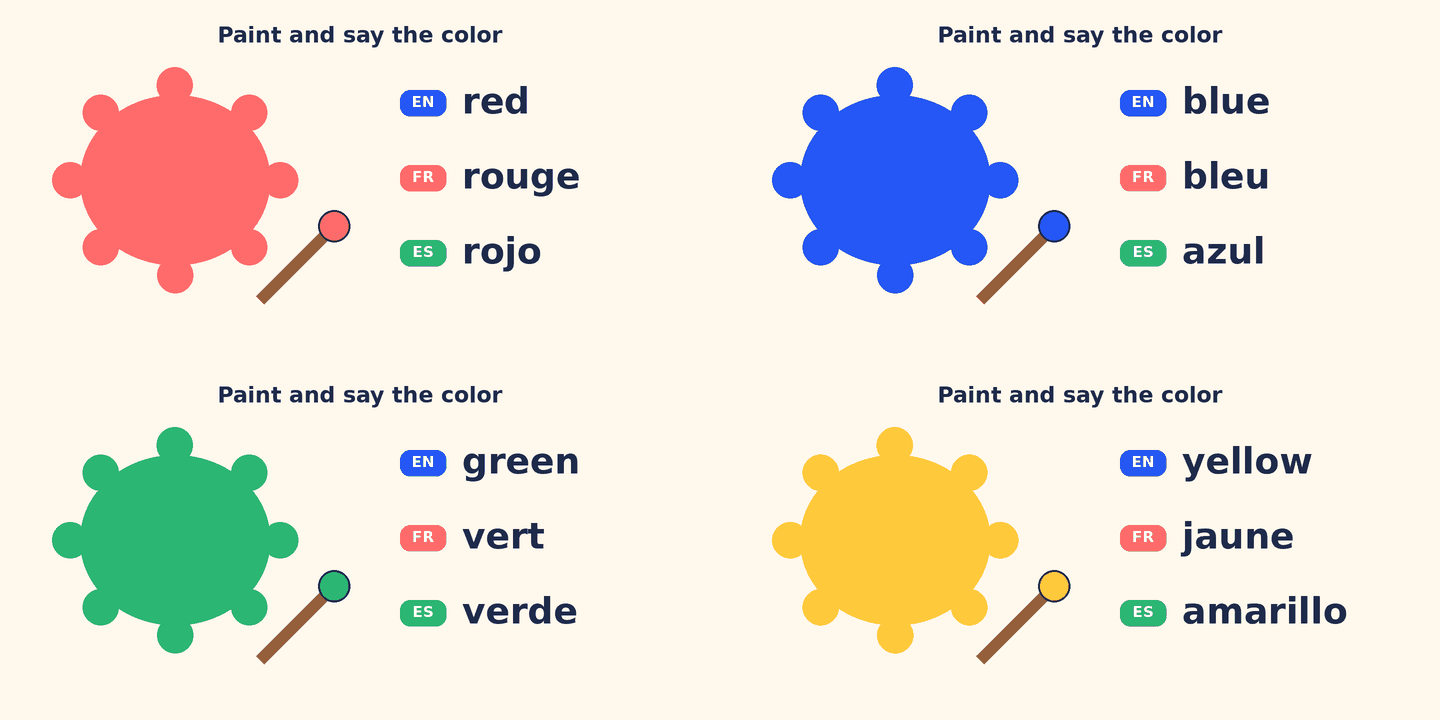
Call out a color in your new language, “rouge!” or “¡rojo!”, and race to find something that color around the house. Then sit down with crayons and color a picture while naming every shade you use.
A printable makes this even better. Try the French flower coloring page and name the petals’ colors as you go, or use the coloring page maker to make a picture of your child’s favorite animal. The English colors word search is a great follow-up for ages 7 and up: find each word, then say it in French or Spanish.
3. Count everything
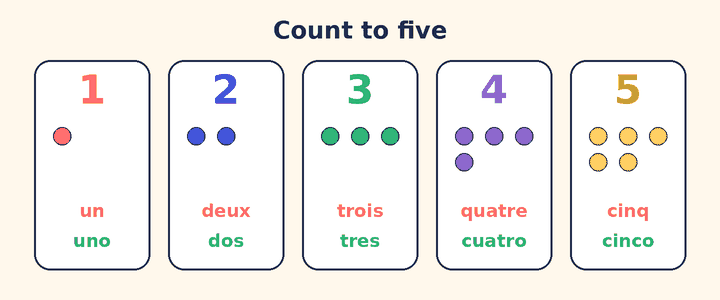
Count stairs, grapes, socks and car doors in your new language. Numbers are perfect because children already understand the idea and only need the new word. Start with one to five, then add a number each week.
Once counting feels easy, try a math sheet in the new language. Every Crayonbird sheet can be made in French or Spanish, so a simple sheet like Count and Compare or Ten Frames becomes a language lesson too. Browse the full French worksheets to get started.
4. Label your home
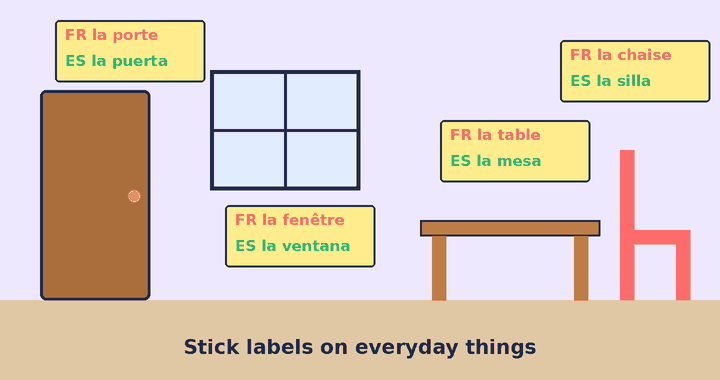
Write the French or Spanish word on sticky notes and put them on everyday objects: the door, the fridge, the table, the window. Your child will see the words dozens of times a day without any effort. Add a “word of the week” note on the fridge for an extra challenge.
5. Play animal games
Animals are a favorite at every age. Make animal noises and name each animal, play “Simon says” with animal moves, or print a bingo card. Spanish learners will love Bingo: Animales, and you can build your own deck with the French flashcard maker.
🐾 Try it now: animal flashcards🐱
tap to flip
🇫🇷 le chat
🇪🇸 el gato🐶
tap to flip
🇫🇷 le chien
🇪🇸 el perro🐦
tap to flip
🇫🇷 l’oiseau
🇪🇸 el pájaro🐟
tap to flip
🇫🇷 le poisson
🇪🇸 el pez
6. Sing songs and rhymes
Songs are language learning’s secret weapon. The rhythm makes words stick, and kids will happily sing the same one fifty times. Traditional favorites like “Frère Jacques” in French or “Los pollitos dicen” in Spanish are easy to find with recordings online.
Rhyming games build the same listening skills. The French rhyming pictures sheet is a fun challenge for confident beginners, and the French phonics lessons teach letter sounds one at a time.
7. Draw it, then name it
Follow a step-by-step drawing lesson in the new language. Your child learns words like “head,” “ears” and “tail” while they draw. Try Cómo dibujar: Gato in Spanish or Comment dessiner un chat in French. Rocket fans can try Cómo dibujar: Cohete.
8. Read the same story in two languages
This is one of the most powerful tricks for beginners. Read a short story in your home language first, so your child knows what happens. Then read it again in the new language. They’ll use the pictures and the plot to work out new words.
Crayonbird makes this easy: read A Picnic on the Moon in English, then Un pícnic en la luna in Spanish. Afterwards, your child can draw their own ending on Spanish story paper.
Common mistakes to avoid
- Turning it into a test. Asking “What’s this in French?” over and over can feel like an exam. Instead, use the words naturally and let your child join in when they’re ready.
- Correcting every mistake. If your child says “el gato” for a dog, simply repeat back the right word with a smile: “Ah, el perro!” That’s all the correction they need.
- Doing too much too soon. Three or four new words a week is plenty for a beginner. Revisit old words often so they stick.
- Stopping when it gets quiet. Many children understand far more than they say at first. Keep going, and the words will come.
Want to stretch confident learners? Ask them to guide you through a French maze using “gauche” (left) and “droite” (right), or practice a first reading word with the French sight word sheet. You can also make any activity from scratch in the French activity maker.
Quick quiz: which language is it? (tap to check)
1. “Gracias” French or Spanish?
✅ Spanish. It means “thank you.” In French, it’s “merci.”2. “Le poisson” French or Spanish?
✅ French. It means “the fish.” In Spanish, it’s “el pez.”3. “Amarillo” French or Spanish? And what color is it?
✅ Spanish, and it means yellow. In French, yellow is “jaune.”
A 10-minute weekly plan
| Day | Activity | New words |
|---|---|---|
| Mon | Greetings at breakfast and bedtime | hello, good night |
| Tue | Color hunt + coloring page | red, blue, green |
| Wed | Count snacks and stairs | one to five |
| Thu | Animal flashcards or bingo | cat, dog, bird |
| Fri | Story in two languages | review the week |
Repeat each week, adding three or four new words at a time. Older children (7+) can move on to topics like telling the time with Aprende la hora. For a structured path in any language, explore Crayonbird’s programmes or the French library and Spanish library.
✅ Your first-week checklist
☐ Choose French or Spanish
☐ Learn 3 greetings together
☐ Make 5 sticky-note labels for the house
☐ Print one coloring page and one story from the French or Spanish library
☐ Find one song to sing together
☐ Celebrate every new word!
Frequently asked questions
Can I teach my child a language I don’t speak?
Yes. Learn together and treat it as a shared adventure. Use songs, picture books and audio from native speakers for pronunciation, and focus on simple, everyday words.Will learning two languages confuse my child?
Mixing words from two languages in one sentence is common and normal for young learners. It’s a sign they’re building connections, and it usually sorts itself out with time.How much time does my child need each day?
Five to ten minutes of regular, playful practice works better than a long weekly lesson. Weave it into routines you already have.Where can I find free French and Spanish worksheets for kids?
Crayonbird’s library is available in ten languages. Start with the French section for ages 3–5, the French section for ages 6–11, or the Spanish library.
The bottom line
Teaching your child a second language at home doesn’t need a classroom or a fluent parent. It needs a few minutes a day, everyday words and plenty of play. Say “bonjour” at breakfast, count grapes in Spanish, label the fridge and read the same story twice. Small steps, repeated often, add up to a real gift your child will carry for life.
Ready to start? Print free worksheets, coloring pages and stories in French, Spanish and eight more languages at Crayonbird, or browse more tips in the parents’ guide.
About Crayonbird: Crayonbird offers learning sheets, games and art for ages 3–18 in English, Spanish, French, Portuguese, German, Italian, Arabic, Hindi, Chinese and Indonesian. Every sheet can be printed or played on screen with instant marking. No ads and no chat.